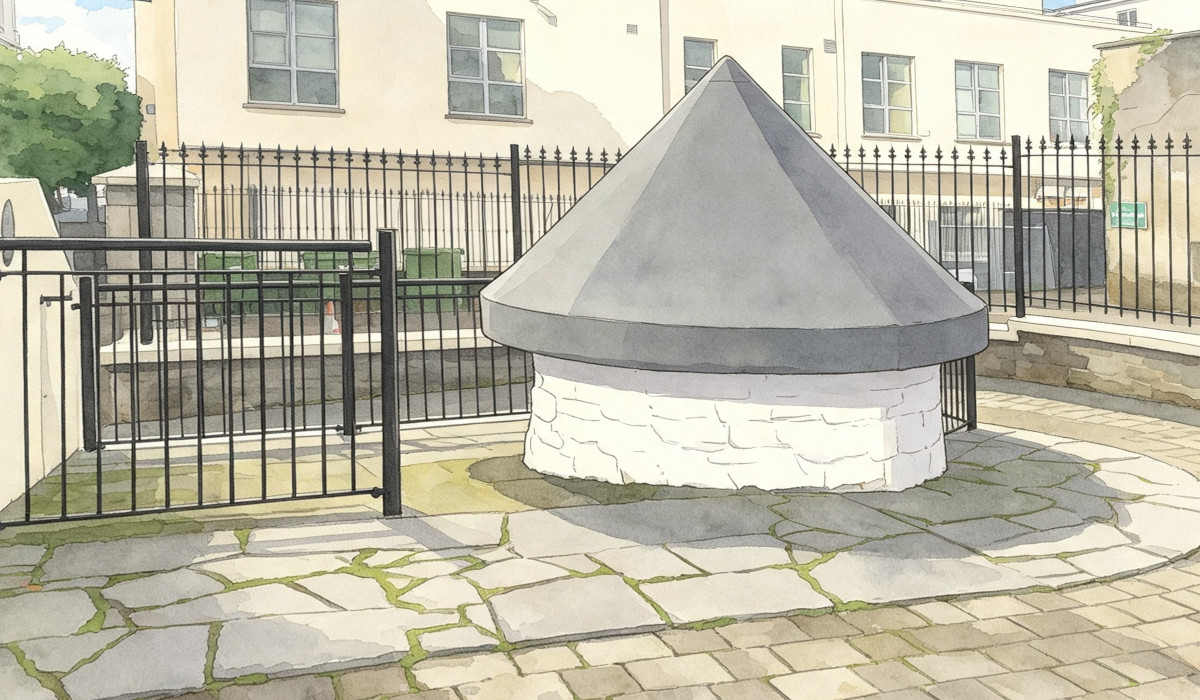
St Mary's Well
A 13th-century holy well on Kenmare Place, officially registered and maintained — yet quietly overlooked by almost everyone who passes it.
History & details
St Mary's Well (Tobar Mhuire) has been venerated on this spot since at least 1302, tied to the ancient name of Killarney itself, Cill Airne. Enclosed in a small whitewashed structure with a blue conical roof, it once drew crowds on the Feast of the Assumption, when people made five circuits of the well and bathed sore eyes and throats in its water — mothers brought children here for sore throats well into living memory. Folklore tells of a blessed trout said to live in the well: those who tried to harm it met paralysis or drowning. Today the well has a tap, a coat of paint, and a National Inventory listing — but nothing left at the water. No flowers, no candles, no offerings.
The well sits opposite St Mary's Church of Ireland, in a cut-through most people use simply to reach a car park behind it — the council offices and a large hotel now crowd the same small space. The circular wellhouse itself dates to roughly 1850, with the conical roof added later; the blue and whitewashed grey colours are widely thought to carry Marian symbolism, fitting for a well whose two feast days — the Assumption (15 August) and the Annunciation (25 March) — both honour Mary, though the exact source of that colour tradition hasn't been confirmed.
Two folk tales about the well's trout survive from the 1930s: one where a man drowned trying to catch it, another where the fish turned to stone after being netted, said to still be visible at the water's edge. Both follow a common pattern in Irish holy-well folklore — the sacred creature punishes those who violate the site.
Whether the August pattern-day tradition survives in any form today is unclear and worth checking locally. What is certain is the contrast with Killarney's other surviving holy well, Cloc Mo Cuda in the National Park — unmarked, unmaintained, and still visited quietly by people who leave rosary beads at the stone.